I’m generally circumspect when it comes to naming specific spirits I work with in my own practice. The one exception is St. Cyprian of Antioch, who was one of my earliest patrons.
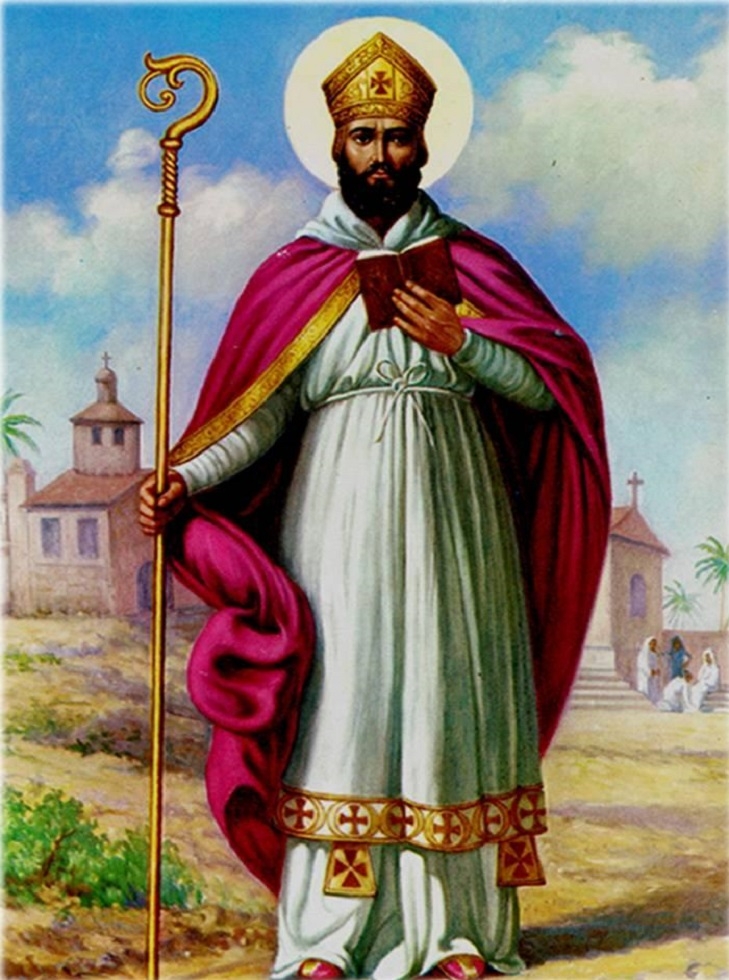
St. Cyprian of Antioch1 is a fascinating figure for those interested in magic, particularly magic in the Solomonic tradition. He was dropped at some point from the official roster of Catholic saints, due to a lack of evidence that he was a real historical figure. But he remains part of the Orthodox Christian canon, as well as being a widely venerated saint in folk-Catholicism.
The most thorough version of the story of St. Cyprian comes from The Life and Sufferings of the Holy Martyrs Cyprian and Justina, translated from a Russian Orthodox text. The broad strokes of the story are as follows:
In the third century, there was born a boy named Cyprian. His parents were devout pagans, and fostered him out at the age of seven to be initiated into the cult of Apollo. He learned much from this mystery school, and as he grew older so too did his thirst for knowledge. At ten he traveled to Mt. Olympus to study the control of winds and tempests with the cult of Jove. At fifteen to the city of Argos to learn from the sorcerers of the cult of Juno. He traveled thence to Tauropolis to study with the cult of Diana, and after that to Sparta to learn the art of calling up the dead. At the age of twenty, he traveled to the city of Memphis in Egypt, to further his study of magic. From there he proceeded to study astrology among the Chaldeans. At the age of thirty, he considered his studies in magic to be complete, and set himself up in Antioch as a learned philosopher and magician.
There lived at the time, in Antioch, a beautiful maiden named Justina. She was a Christian convert, and very devout in her faith. One day, as she was making her way to church, she was spied by the young nobleman Aglaias. Aglaias was vain and spoiled, and utterly overcome with his desire for Justina. He tried a variety of mundane means to seduce her, but was always rebuffed. Finally, in desperation, he went to the magician Cyprian and enlisted his aid.
Cyprian conjured up a demon, and set it forth to incite lust in the breast of Justina. But when Justina felt the demon at work, she prayed and made the sign of the cross, and the demon was rebuked. Cyprian conjured up a more fearsome demon, and set it to the same task. Again Justina’s faith and the sign of the cross drove it away. Finally, Cyprian conjured up a third and most terrible prince of demons to win Justina for Aglaias. This third demon too was confounded by the sign of the cross.
At this point Cyprian was awed by the power of this Christian faith over his own pagan teachings. He burned his spellbooks and went to the bishop of Antioch, renouncing his previous faith and converting to Christianity. Through his quick mind and dedicated study, he was soon anointed a bishop in his own right. He maintained a steady – but platonic – friendship with Justina, whose actions had led him to conversion.
During this time, the Christians were under persecution by the Roman state. The governor Eutolmius imprisoned both Cyprian and Justina, and tortured them to force them to renounce their Christian faith, but both refused. They were ordered to be put to death by being thrown into a boiling cauldron, but this punishment did them no harm. Eventually, both were executed by beheading – martyrs to the Christian church.
Different groups take different ideas from the story of St. Cyprian. For devout Christians, it’s a story about the triumph of Christ over demonic magic. Here Cyprian is a patron saint of late conversions, and those who come to Christianity through non-traditional paths. Pagans can see a spark of defiance, where Cyprian converts but never renounces his magical practices. Here it is more about the accumulation of one more powerful tradition, of hacking the technology of the church to turn it towards more sorcerous ends. Finally, Solomonic practitioners can see a resonance with their own journey, reaching for the divine to better control the infernal. In that context Cyprian is as close to a “patron saint of magicians” as we are likely to find.
And the official accounts end there. But, as with the figure of Solomon himself, there is a large body of folklore that has grown up around the figure of St. Cyprian. These legends state that Cyprian’s spellbooks were not destroyed, but merely hidden, later to be found. Or that his conversion was never about faith, but about the pursuit of still greater power, and he continued practicing magic in this new tradition as well.
Today, there are three distinct occult traditions that reference St. Cyprian. The first is in Scandinavia, where sorcerers keep little black books in which they record their spells. These books are literally called Cyprianus books, in reference to the lost spellbook of St. Cyprian, regardless of whether their contents actually refer to St. Cyprian or spirit conjuration.
The second tradition is in the Iberian peninsula, where a variety of grimoires are attributed to St. Cyprian. In this area, St. Cyprian is seen as a somewhat darker and more fearsome figure. Most of the Cypriantic cartomancy systems come from this region.
Finally, there is a tradition in South America that venerates Cyprian as a folk-saint. In this context, Cyprian is primarily worked with for protection, but also occasionally for healing or love matters. To that end, there are a variety of San Cipriano candles, oils, or novenas that you can find in your local botanica.
Regardless of your tradition, St. Cyprian is something of a liminal figure. He has the skills to traffic with both heaven and hell. He stands at a balance point, able to mediate opposing forces, and operate within opposing paradigms. That fluidity is something that I’ve found to be very powerful in my own personal practice.
- As distinct from St. Cyprian of Carthage, who is an entirely different figure. ↩︎