Over the last four months, I’ve been writing a series of posts that explore the nuances of Solomonic spirit conjuration as a technology we can (and should!) apply in our magical practice. The series has taken turns that I never expected, ultimately clocking in over fifteen thousand words across twelve posts.
For folks who haven’t been following along as I was going, I want to have one final post that gives a high-level overview of the series, as well as providing an index for quick-reference in the future. For those who prefer to consume their media in a more traditional format, or want an offline copy, the entire series has been typeset as a PDF available here.
I also want to take a moment here to briefly address some of the most common criticisms made of Solomonic magic, and make the case that it is both more approachable and more valuable than it gets credit for. So without further ado, let’s take a look at some of the critiques frequently leveled at Solomonic magic:
Solomonic magic is confusing. This one is… kind of fair actually. Most historical grimoires are dense, archaic, poorly structured, or all three. There are a few gems among modern grimoires, but they’re lost among a sea of lower quality content: edgy reskins of basic chaos magick, strong assertions of dubious claims, and (more recently) AI generated rubbish.
This state of affairs is part of what prompted me to write this series in the first place. Solomonic spirit conjuration rituals have an underlying structure and coherence, and a familiarity with that structure makes it much easier to read a historical grimoire and notice where elements might be missing or out of order. For readers who like this idea and want to pursue it further, I would recommend Aaron Leitch’s book Secrets of the Magickal Grimoires, as well as Dr. Stephen Skinner’s Techniques of Solomonic Magic.
Solomonic magic is inherently confrontational/adversarial/exploitative. It’s easy to see how this idea got started – perusing the grimoires gives plenty of examples of conjurations that bind demons by the power of God, or threaten them with harsh punishments unless they appear and obey. However, I would argue this is also a misconception. Our most coherent surviving grimoires were authored by Christians (or at least during predominantly Christian times), and that is the lens through which they view spirit contact. The underlying technology however – consecrations, circle, invocations and evocations – is far older. There are knobs you can turn in a ritual to dial confrontation up or down while remaining true to the underlying Solomonic framework; you can make the conjuration a friendly invitation or full-on fire and brimstone exorcism, depending on your tastes.
Solomonic magic is needlessly complex. You see this assertion a lot coming out of chaos magick circles, and most of the debates on it aren’t productive because they’re grounded in a fundamental disagreement about how magic works. If you view magic as primarily about hacking your own beliefs, then anything beyond a doodled sigil is needlessly complex. But it’s worth noting that grimoires laying out elaborate and explicit ritual instructions were prized possessions; people went to the trouble of laboriously hand copying them and secreting them away in an era where doing so could carry a literal death sentence. You’d think if “believe real hard” or “just meditate bro” were as effective for generating results, they wouldn’t have gone to the trouble.
If you’re on the fence, all I can do is encourage you to give Solomonic methods a try. Either you’ll see a difference in results or you won’t. I can only speak to my own personal experiences, but the real-world effects I’ve seen from my Solomonic practice are wildly more concrete than what I was able to achieve through chaos magic. It’s not even close.
I hope by now to have made the case that Solomonic magic is at least worth experimenting with. Let’s look at the posts that form this series, giving a quick summary of each:
- Solomonic Magic In Practice: A General Framework for Conjuration
This post defines what Solomonic magic is, and discusses a couple different frameworks for thinking about the structure and sequencing of Solomonic spirit conjuration rituals. - Solomonic Magic in Practice: Exorcism and a Clean Slate
This post begins a discussion of the preconsecration of ritual implements by looking at the first stage in many Solomonic consecrations: the exorcism of the tool in question. - Solomonic Magic in Practice: Blessings and Consecrations
This post continues the discussion of preconsecration of ritual implements, looking at the second stage: blessing and sanctification of the implement. This whole process of consecrating a ritual tool is recapped here. - Solomonic Magic in Practice: Drawing the Circle
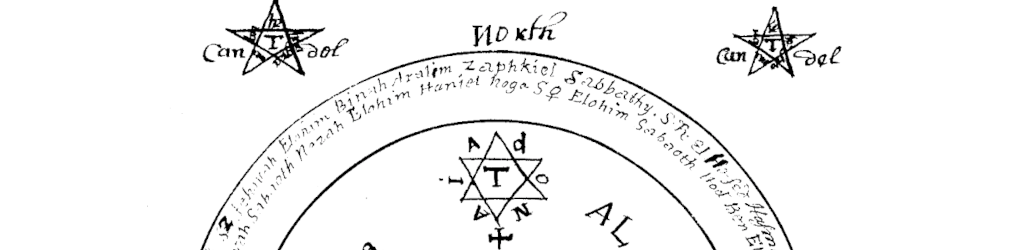
This post looks at magical circles in a Solomonic context. It considers some of the possible reasons why a magician might want to use a circle, as well as looking at some example circles from common grimoires. - Solomonic Magic in Practice: Personal Purity
This post looks at the idea of physical and spiritual cleanliness in preparation for a spirit conjuration. The possible incorporation of fasting, bathing, and confession are considered. - Solomonic Magic in Practice: Calling the Powers
Where everything up to this point has addressed preparation before a ritual, this post looks at the beginning of the Solomonic conjuration itself. Here various powers are invoked for authority and aide, to imbue the magician with the power to successfully call a spirit to them. - Solomonic Magic in Practice: Choosing a Spirit
Breaking briefly from our discussion of the ritual script, this post looks at how one can choose a spirit to conjure. It covers using spirit catalogs and mythology as sources, and what to do if you’re missing the name, seal, or office of a spirit. - Solomonic Magic in Practice: Making Contact
Another sidebar, this post discusses different levels of spirit contact, ranging from mental resonance to full-blown physical manifestation. The pros and cons of various levels are considered, and how aiming for a particular level of spirit contact might influence your ritual design. - Solomonic Magic in Practice: Calling the Spirits
Returning to our discussion of the conjuration script, this post dives into the conjurations used to evoke and bind a spirit. The sliding-scale nature of these conjurations is considered, and how we might choose to dial our level of confrontation up or down depending on our own tastes and the nature of the spirit being contacted. - Solomonic Magic in Practice: Defining the Boundaries
This post discusses how to welcome a spirit when it appears, and set the terms of engagement for the following interaction. It includes some discussion of the Pentacle of Solomon figure, and when one might choose to use it. - Solomonic Magic in Practice: The Spirit’s Reply
This post covers the actual communication with the spirit. It deals with making requests or getting information from a spirit, how to strike the right tone during an interaction, and includes some discussion of spirit offerings (and the common pitfalls associated with them). - Solomonic Magic in Practice: Ritual Innovation
This post talks about how to negotiate a revised ritual for contacting a spirit again, and how one can set oneself (and others) up for success in future conjurations. - Solomonic Magic in Practice: The License to Depart
Closing out the cycle, this post talks about the final license to depart. A couple examples are given, and there is some discussion of what to do if a spirit doesn’t want to leave after it has been summoned.
Ready to dive into the series? Get started with the first post.