Over the last few weeks we’ve explored the idea of consecrations in the Solomonic tradition. That everything brought into the ritual space is exorcised and blessed ahead of time, to give the magician a spiritually clean environment in which to work. There are two final pieces we haven’t talked about yet: the purification of space, and the purification of self. This week we’re going to be talking about space.
You certainly can consecrate space in the same way we consecrate anything else – holy water and incense, reciting prayers of exorcism and blessing. In fact many Solomonic operations start with exactly that. But there is another element to creating a ritual space that is hugely important in the Solomonic tradition, and that is the creation of a ritual circle.
The idea of a circle to surround and protect the magician during a spirit conjuration goes back millennia. In Graeco-Egyptian magic, it sometimes took the form of a snake, laid out in a circle, biting its own tail. Sometimes the circle was traced with a sharp iron blade as part of the ritual, to give it further protective and apotropaic qualities.
As spirit conjurations got Christianized, the form of these circles changed. They became more elaborate, including many layers of divine names, angels, or spiritual powers. The function, however, was more or less the same: a shield to separate the operator from potentially hostile spiritual powers.
Why is a circle necessary? It’s been a subject of substantial speculation, and I don’t know that anyone can ever answer it definitively. I’ll present a number of theories here, and let you draw your own conclusions.
The first idea, influenced by Wicca, is that the circle is an energetic barrier. While it may function to keep hostile spirits out, it is equally important in keeping the energies of the ritual in. It separates the ritual space from mundane space, prevents the energy raised in ritual from dissipating, and thereby makes the ritual more powerful. Think about the efficiency difference between a fire burning in the open air, versus inside a wood stove. In this paradigm, the circle is as much for you as it is for the spirit.
The next idea is that the circle helps to locate the ritual in time and space. Spirits don’t experience spacetime the same way we do, so when called in a Solomonic operation, they may struggle to identify where the call is originating. The existence of a circle, particularly one that includes time-based powers such as the angels of the day and hour, can serve as a beacon to help them locate us and initiate contact.
Those theories are both somewhat modern, treating the circle as ritual tool as much as protection. What about circles as a more traditional protective element?
Many traditional conceptions of spirits involve them being a little bit OCD. The classical devil trap bowls, for example, are earthenware bowls with prayers written on them in a spiral. The idea being that a spirit encounters the bowl, feels compelled to read the prayer, follows it into the center of the spiral, and then can’t figure out how to get out.1 A protective circle might work in a similar way: a hostile spirit encountering it tries to follow it to the end, and because a circle has no end, gets stuck going around and around.
A second option is that it’s more analogous to a personal mandala: it represents the structure of the universe as you understand it, and the powers you have aligned yourself with within that conception. In this case it’s less about the spirit being unable to breach the circle, and more about them being reluctant to do so because they don’t want to tick off the powers you’ve named as your protectors, allies, or source of authority.
Regardless of the exact mechanics at play, the inclusion of a ritual circle is one of the most important components of a ritual in the Solomonic tradition. Let’s look at a couple classic (if highly complex) examples.
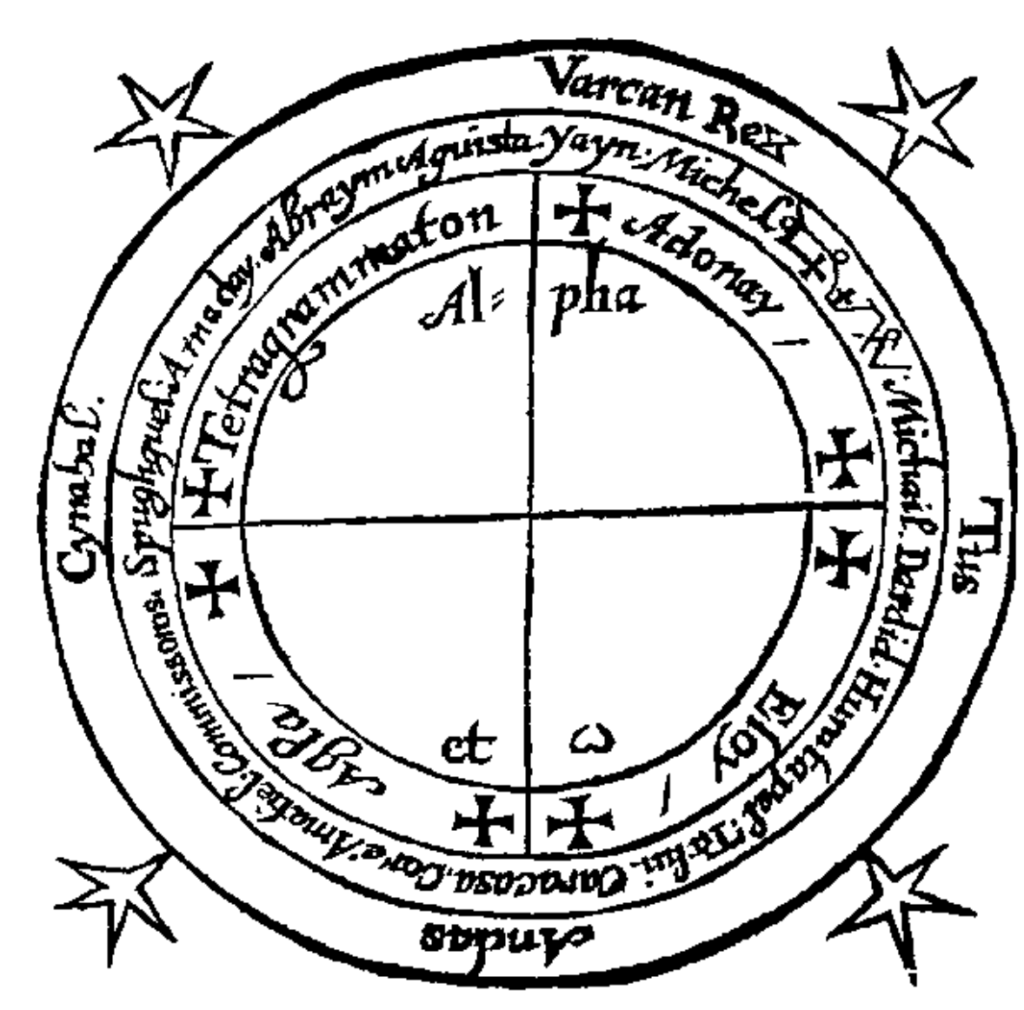
The first example is drawn from the Heptameron. It is composed of three rings of names. The innermost ring contains names of God, the outermost the names of the spirit(s) which you are attempting to conjure. The middle ring contains names, angels, and ministers of the season, day, and hour, sun, and moon. This composition of the circle localizes the ritual in spacetime and shows that the magician has the appropriate keys to conduct the operation.
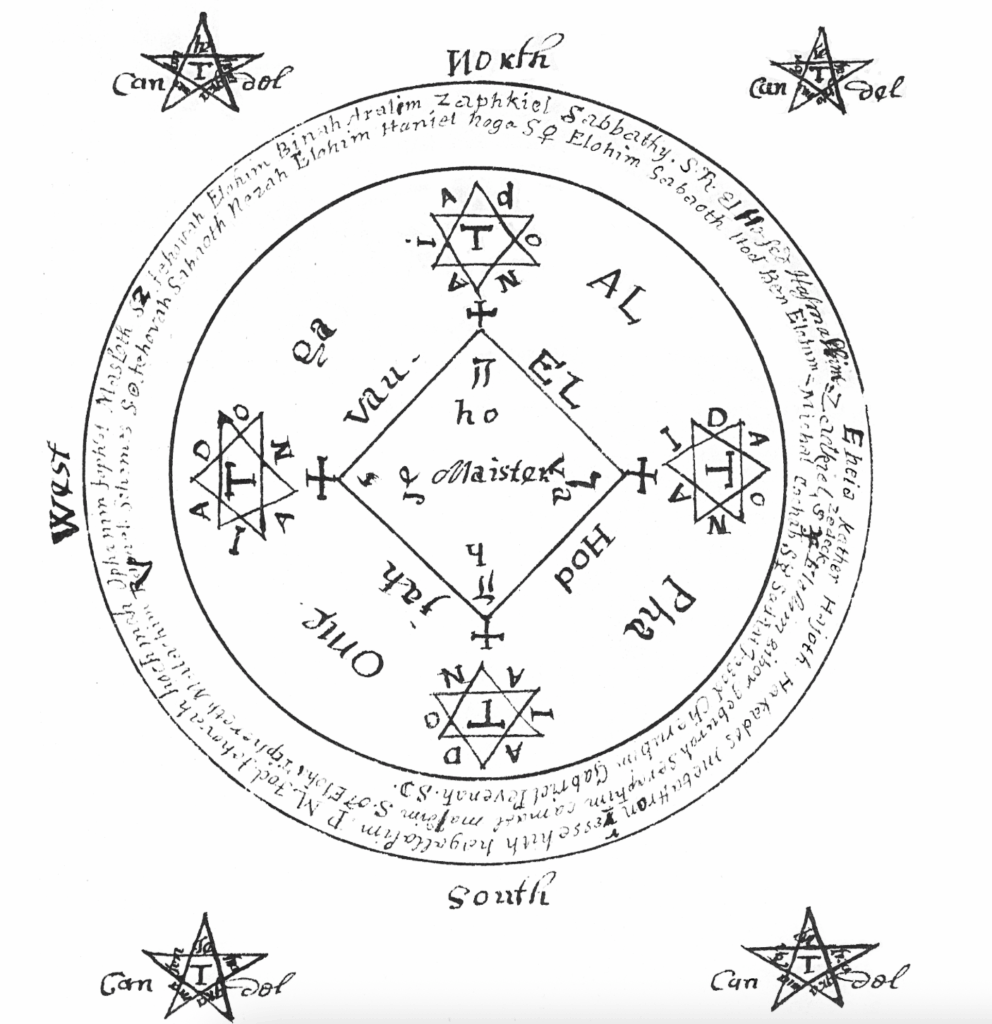
The second example is drawn from the Lemegeton’s Goetia. It contains the sphere names, divine names, and angelic rulers and orders assigned to each of the ten sephira of Qabalistic tradition. In this sense, it echoes the path of creation found in the Qabalistic Tree of Life, representing the magician’s understanding of the creation of the universe.
A number of other circles exist, of greater or lesser complexity. Experimenting with any of the circles shown here is encouraged, as is crafting your own, that includes the divine names, guardians, and patrons most appropriate to your practice.
Once you have a circle drawn out, how do you actually consecrate it? Rituals vary slightly on this. Some perambulate around the circle, sprinkling it with holy water and perfuming it with incense, reciting prayers of exorcism and blessing similar to those discussed in previous posts. If the circle has a long list of magical names, they may be recited and called upon for protection. Many rituals trace around the circumference of the circle with a blade or wand, declaring it to be hallowed space. From The Art of Drawing Spirits into Crystals:
In the name of the blessed Trinity, I consecrate this piece of ground for our defence; so that no evil spirit may have power to break these bounds prescribed here, through Jesus Christ our Lord. Amen.
From the Sixth and Seventh Books of Moses:
Ego consecro, et benedico istum Circulum per Nomina Dei Attissimi [sic] in eo Scripta, ut sit mihi et omnibus Scutum et Protectio Dei Fortissimi ✠ Elohim ✠ Invincibilis contra omnes malignos Spiritus, eorumque Potestates. In Nomine ✠ Dei Patris ✠ Dei Filii ✠ Dei Spiritus Sancti. Amen.
[I consecrate and bless this Circle by the Names of the Most High God written therein, so that it may be for me and for all a Shield and Protection of the Most Mighty God ✠ Elohim ✠ Invincible against all evil spirits and their powers. In the Name ✠ of God the Father ✠ of God the Son ✠ of God the Holy Spirit. Amen.]
Magicians that come from a modern ceremonial tradition – such as the Golden Dawn or Thelema – may opt to include their own rituals for banishing and consecrating space, such as the Lesser Banishing Ritual of the Pentagram or Hexagram. Not strictly traditional, but able to integrate well into the remainder of a Solomonic operation if such rituals are already part of your practice.
A circle is one of the most consistent ritual elements of Solomonic conjuration. Whether you choose to view it as a protective device, a beacon to draw the spirit to you, or a container to preserve the delicate energies raised in the ritual, it serves to set the ritual space off from the mundane world. It marks the space of the operation as a world apart. A sacred place in which to conduct our sacred work.
This post is part of a series on Solomonic magic. You can find the next post here.
- Scattering seeds in front of your door is a traditional way to ward off vampires; one of the explanations that I’ve heard for that is similar – that the vampire will feel compelled to stop and count the seeds, which prevents it from causing harm. ↩︎