We’ve now made it up to step four in our Solomonic conjuration framework: Constrictio. We’ve performed all our invocations and evocations, and made contact with the spirit. From here on out the ritual will proceed quickly; the main hurdle has already been overcome.
The constrictio step is a reiteration of the boundaries you wish to place on the interaction with the spirit, stated after the spirit has appeared. It generally includes such limitations as the spirit appearing before the circle in a fair and visible form, speaking to you clearly and truthfully, not departing before you have given them license to, and doing no harm to person or property as they arrive or depart.
Such a step is not, strictly speaking, necessary. If you are performing a friendly conjuration of generally beneficent spirits, as discussed last week, it is usually assumed that the spirit is operating with your best interests in mind. Layering on additional parameters and restrictions is unnecessary. Similarly, you may opt to bake these restrictions into the conjurations used in the previous step – summoning the spirit to appear and fulfill all those requirements by whatever spiritual authority you are using. In this case too, a further limitation on the spirit is unneeded.
For both of these reasons, the number of grimoires lacking an explicit constrictio step is far greater than the number of grimoires containing one. However, in cases where you are forcefully conjuring a spirit who is reluctant to appear, it may be helpful to make such expectations explicit. The assumption in the grimoires apparently being that spirits might otherwise attempt to trick the operator or nullify the conjuration: remaining invisible even when present,1 appearing in a terrifying way, speaking unintelligibly or giving false information, etc.2 If you’re worried about such outcomes, an explicit clarification of your expectations around the communication is a historically attested option.
The two most popular sources that contain explicit examples of this step are the Lemegeton’s Goetia, and pseudo-Peter of Abano’s Heptameron. The conjurations are very similar between the two, and I will quote those of the latter as they are older and somewhat more detailed:
Behold the Pentacle of Solomon, which I have brought before your presence. Behold the person of the Exorcist in the middle of the Exorcism, who is armed by God, and without fear, and well provided, who potently invocateth and calleth you by exorcising; come therefore with speed, in the virtue of these names, Aye, Seraye, Aye, Seraye; defer not to come by the eternal Names of the living and true God, Eloy, Archima, Rabur, and by the Pentacle here present, which powerfully reigns over you, and by virtue of the Celestial Spirits your Lords, and by the person of the Exorcist, being conjured, make haste to come and yield obedience to your Master, who is called Octinomos.
Welcome Spirits, or most noble Kings, because I have called you through him to whom every knee doth bow, both of things in Heaven and things in Earth, and things under the Earth, in whose hands are all the Kingdoms of Kings, neither is there any that can contradict his Majesty. Wherefore I bind you, that you remain affable and visible before this Circle, so long and so constant; neither shall you depart without my licence, until you have truly and without any fallacy performed my will, by virtue of his power who hath set the Sea her bounds, beyond which these cannot pass, nor go beyond the Law of his Power, to wit, of the most high God, Lord and King, who hath created all things. Amen.
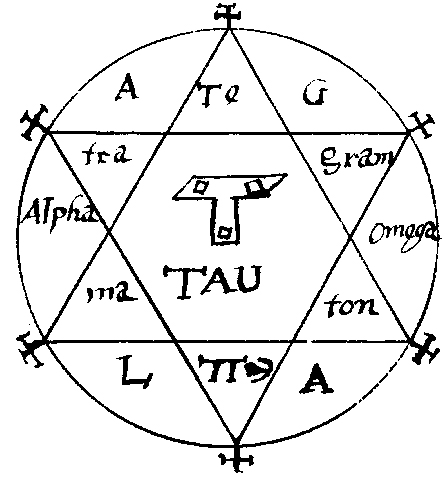
In both sources, the first paragraph is paired with the revealing of a glyph of power known as the Pentacle of Solomon, at whose appearance the spirits are purported to become obedient to the magician. The exact depiction of this figure varies by source, but by comparison the themes can become apparent.
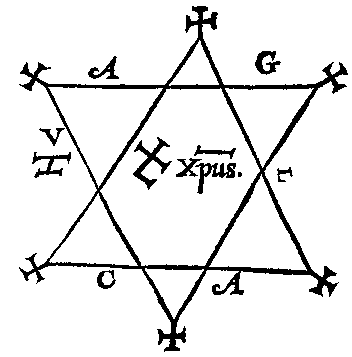
The Pentacle of Solomon as it appears in a manuscript of the Heptameron.
A figure of similar form and function – “Salomon’s sextangle figure” – appearing in a manuscript of the Goetia.
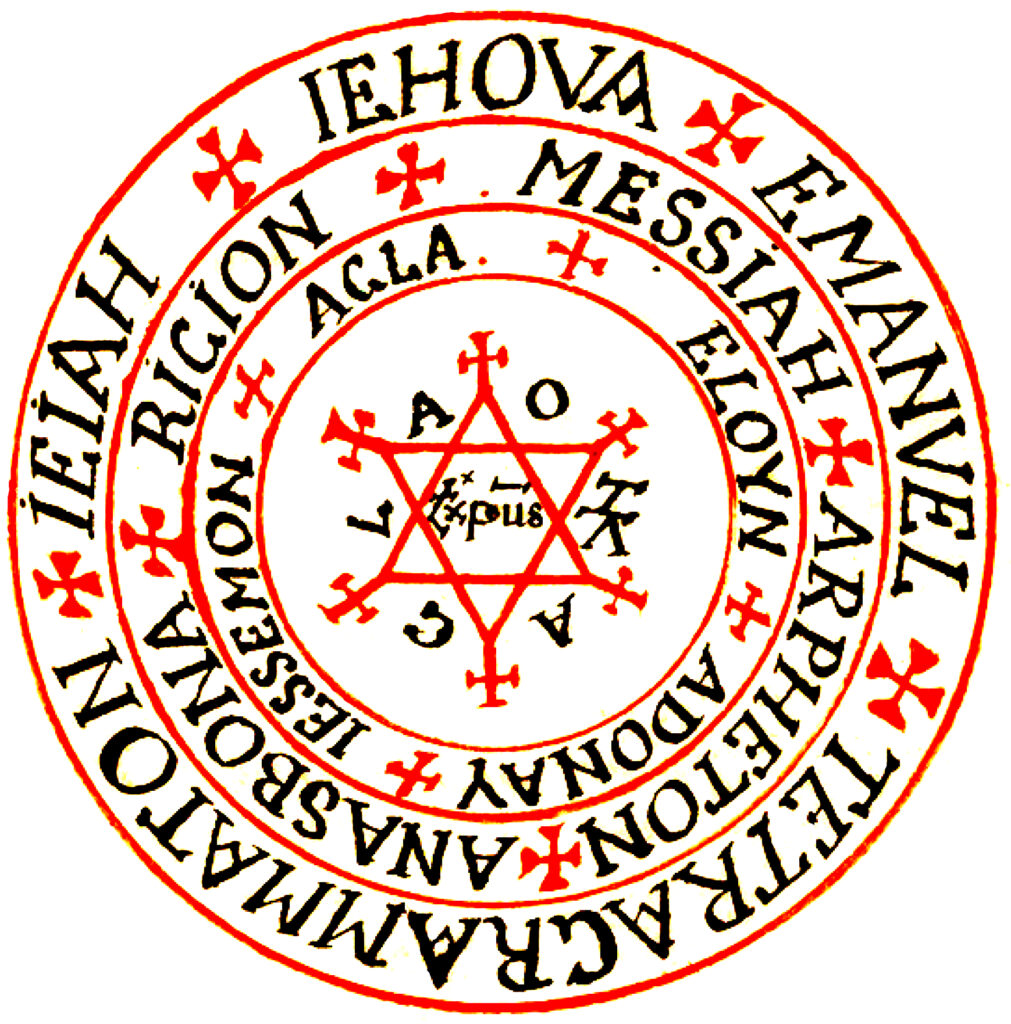
A figure of similar form and function – the “Pentacle or Three Rings of Solomon” – appearing in a manuscript of the Grimorium Verum.
In each case the figure is primarily composed of a six-pointed star, reinforced with divine names (most notably Tetragrammaton and Agla).
For a friendly conjuration, or the conjuration of a beneficent spirit, this step can be omitted entirely. If you are treating the conjuration more in the vein of an exorcism, where spirits are compelled to appear and obey against their will, then you may opt to include an explicit constriction step after the conjurations when the spirit has appeared. In this case, using the Pentacle of Solomon figure and the conjuration from either the Heptameron or the Goetia seems like an excellent option.
This post is part of a series on Solomonic magic. You can find the next post here.
- As depicted in Susanna Clarke’s excellent novel Jonathan Strange & Mr Norrell. ↩︎
- It is not clear to me how much this is a real concern, versus something grounded in Christian superstition around “demonic” entities and the way they interact with the world. Most western grimoires were written in a period in which the assumption was any earthly spirit was a demon bent solely on the temptation and corruption of humanity. This seems to me to ignore a tremendous amount of variety and nuance found among sub-celestial spirits. ↩︎