Last month I wrote about how different divination systems have different characters and vocabularies. One of the systems I referenced repeatedly was playing card cartomancy. It’s one of my favorite systems, so I’d like to start a new post series walking through the basics of that.
First off, what is cartomancy? Cartomancy is a form of sortilege – divination by casting lots – using cards drawn from a deck to divine information about the world. Far and away the most common form of cartomantic divination used today is tarot, in large part due to its inclusion in the curriculum of the Hermetic Order of the Golden Dawn. There are also a huge number of oracle decks available to the modern reader, all created specifically for divination.
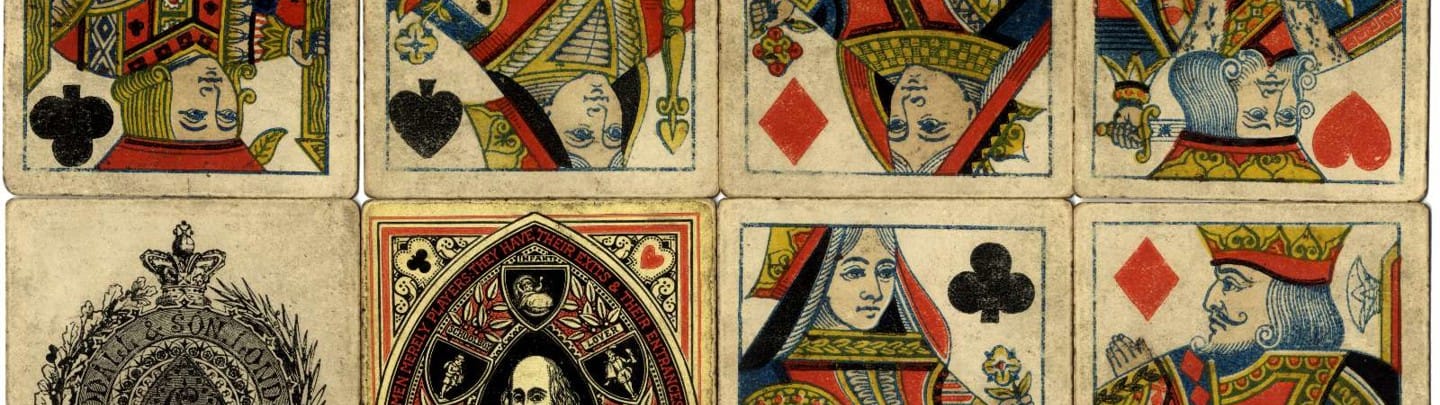
The origins of cartomancy, however, are much more pragmatic. Packs of cards intended for games provided a convenient set of unique symbols that could be assigned meanings, drawn at random, and interpreted. Detailed tarot decks were popular with the upper classes, with Renaissance decks often having beautifully illustrated major arcana depicting various religious or moral themes. These early tarot decks are true works of art, but even the common paper cards used by the lower classes for gambling found their way into use in divination.
Because of this class divide, there are some notable differences between tarot and playing card cartomancy. Tarot eventually converged into a standard 78-card deck (split between 56 minor arcana in four suits and 22 major arcana). The meanings assigned to these cards in divination are mostly consistent across modern tarot readers. Individual readers might have different shades of meaning attached to particular cards, but the broad significance will be the same.
In contrast, playing card cartomancy never saw a similar convergence. Even among systems that utilize a standard deck, there are dozens of different ways to assign meaning to the various cards. And that’s even before we get into things like Lenormand, which generally uses a subset of the cards. This makes it more challenging to combine sources when learning to read; different systems can assign wildly different meanings to cards. None of those are necessarily better or worse, but you’re better off going deep on one particular system than trying to dabble in many. The latter approach tends to muddy the waters.
The link between playing card cartomancy and folk magic also means the symbols associated with the cards tend to be pragmatic. These systems provide advice on love, work, finances, and relationships – the kinds of things everyday people need advice on.
There are a couple common ways to assign meanings that I’m not planning to cover, and I want to get those out of the way up front. First, it’s possible to read playing cards just like tarot. You have to have the cards memorized, because you’re missing the pictorial cues, but you can treat your deck exactly like the minor arcana. If you’re an experienced tarot reader in desperate need of a reading but without a deck, this is fine. I don’t consider it ideal.
The second system is Lenormand. Lenormand uses a reduced 36-card deck, where the cards are read in pairs. Cards can have different shades of meaning, depending on whether they are in a primary or modifier position. Lenormand is a great system, I’ve seen it yield some incredible results, but it’s not the one I’m planning to cover here.
The system I practice draws significantly from Cory Thomas Hutcheson’s book Fifty-Four Devils.1 It’s a system that has a nice internal logic to it, with a consistent matrix of meanings assigned to the various suits and numbers. It also dovetails fairly nicely with the HedgeWytchery system, originally available online, and later outlined in The Wise & Subtle Arte of Reading Cards (which is unfortunately out of print, and hard to find).2 There are some differences in meaning, particularly when you get into imagery of specific cards, but the suits and numerology are similar.
Over the next few posts, I’m planning to cover the colors, suits, and numbers in detail, then speak to some of the practicalities of spreads and interpretation. My hope is that this can become a resource for folks learning playing card cartomancy, and spread knowledge or a rich and practical divination system.
Let’s look at the posts that form this series, giving a quick summary of each:
- Playing Card Cartomancy I: The Colors
An exploration of how dominant color impacts a reading, using the example of a simple, three-card spread. - Playing Card Cartomancy II: The Suits
An exploration of the meanings of the four suits, and how their progression tells a story in a reading. - Playing Card Cartomancy III: The Aces
An exploration of the aces of all four suits, and their similarities and unique imagery. - Playing Card Cartomancy IV: The Twos
An exploration of the twos of all four suits, and their similarities and unique imagery. - Playing Card Cartomancy V: The Threes
An exploration of the threes of all four suits, and their similarities and unique imagery. - Playing Card Cartomancy VI: The Fours
An exploration of the fours of all four suits, and their similarities and unique imagery.
Ready to dive into the series? Get started with the first post.
Leave a Reply