Overview
Rosemary has a fascinating dual nature, associated both with the sun and with the sacred feminine. Like many solar herbs, it has a long history of use for protection and the banishing of baneful influences, sometimes being burned as a stand-in for frankincense. However it is energetically nurturing, rather than combative. This balanced nature makes it a strongly cleansing and protective herb, with a legacy of historical use clearing the air in sickrooms and surgeries.
Medicinally, rosemary is used to ward off minor illnesses, relieve stress and digestive upset, and boost the health of the brain through its circulation-improving and antioxidant properties. Magically, it is used to ward away nightmares, hostile spirits, and the evil eye, and to ensure vibrancy and restful sleep.
Botany
Common Name: Rosemary
Botanical Name: Salvia Rosmarinus (formerly Rosmarinus Officinalis)
Family: Lamiaceae
Native Region: Native to the Mediterranean and the Iberian peninsula.
Geographic Distribution: Widely cultivated as a kitchen herb.
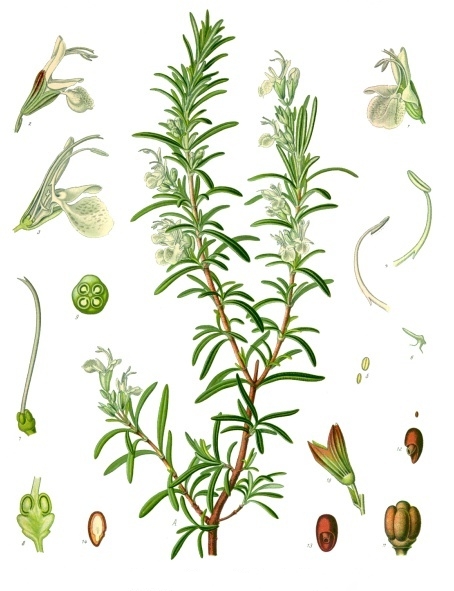
Botanical Description: A woody, evergreen shrub. Form can be either upright or trailing, depending on the cultivar. Needles are aromatic, ¾–1½ in (2–4 cm) long, and green above with a downy white stripe underneath. Flowers are distributed in clusters of 2 or 3 down the length of the branch, and can be white, pink, purple, or deep blue.
Harvesting and Safety
Parts Used: Needles, essential oil
Harvesting Guidelines: Needles can be harvested year round, but are especially potent in late summer when the weather is hot. After being harvested, they can be air dried for storage.
Safety Issues: Rosemary essential oil should only be used externally.
Medical Usage
Energetics: Warming and drying
Actions: Anti-inflammatory, antimicrobial, antioxidant, antispasmodic, astringent, bitter, calmative nervine, carminative, cholagogue, circulatory stimulant, diaphoretic, expectorant, vascular tonic
Uses: Rosemary is both a carminative and calmative nervine, making it excellent at settling stomach upset caused by stress and anxiety (Herbal Academy 2021). The volatile oils of rosemary are antimicrobial and diaphoretic, making it a useful ally for treating sore throats, coughs, colds, and flu (ibid). The antioxidant properties of rosemary, as well as its action as a mild vascular tonic, make it excellent for improving the circulation in the brain, boosting memory and focus, and combatting the effects of aging (Easley 2016). Used topically, rosemary eases aching joints and symptoms of rheumatism (Chevallier 2016).
Pharmacology: Rosemary contains a volatile essential oil with over 150 phytochemicals, including rosmarinic acid, camphor, A-pinene, and caffeic acid.
Specific Indications:
- For sore throats, coughs, colds, and flu, an infusion of rosemary needles can be drunk or used as a gargle (Herbal Academy 2021).
- A similar infusion of rosemary can be taken internally to calm digestive upset due to stress or anxiety (Herbal Academy 2021).
- A similar infusion of rosemary can be taken internally to boost brain circulation, improve memory and concentration, and combat migraines and the effects of aging (Easley 2016 and Chevallier 2016).
- A decoction of rosemary used as a wash, or a salve including its essential oil, can be used topically to ease aches and rheumatic symptoms (Chevallier 2016).
Preparation and Dosage:
- Infusion, 1 cup, up to three times daily
- Tincture, 10 drops to 3 ml, up to three times daily
- Wash or salve, apply topically as needed
Magical Usage
Temperature: Fiery – warm and dry
Astrology: Sun in Aries, also associated with the fixed star Alphecca.
Folklore: Despite its solar character, rosemary is strongly associated with the sea (from the Latin ros marinus, “rose of the sea”) and the Virgin Mary. It was said that an herb garden with a thriving rosemary bush indicated that a woman ruled the household.
In ancient Greece, it was worn by students to improve memory during exams. It is also a protective herb, used to banish hostile spirits and malignant influences – notably one of the three cleansing herbs listed in the Grimorium Verum. Laid under a pillow or a bed it is said to banish nightmares and ensure peaceful sleep. The root of rosemary can be burned as a substitute for frankincense.
References
- Chevallier, A. (2016). Encyclopedia of Herbal Medicine. Penguin Random House.
- Cunningham, S. (2000). Cunningham’s Encyclopedia of Magical Herbs. Llewellyn Publications.
- Easley, T. (2016). The Modern Herbal Dispensatory. North Atlantic Books.
- Greer, J. (2005). Encyclopedia of Natural Magic. Llewellyn Publications.
- Herbal Academy. (2021). Introductory Herbal Course – Recipes and Monographs. Herbal Academy.