Overview
Continuing with our treatment of purifying herbs, our next entry is on mint. Mint is mentioned in several grimoires – such as the Grimorium Verum and the Greater Key of Solomon – among the herbs used to sprinkle holy water when consecrating implements for ritual work. While the variety of mint to be used is not specified, peppermint is especially high in aromatic compounds, which makes it the go-to for medical uses.
Medicinally, mint helps support the body against infection, especially infection of the respiratory tract. It can be used topically to protect wounds, soothe aches, and ease breathing. It is also a potent remedy to settle the stomach and soothe symptoms of gastric distress.
Energetically, mint is prolifically expansive. In addition to its protective and purifying properties it has strong ties to the sphere of Mercury, making it a forceful ally in matters relating to travel, commerce, and generally clearing blockages and getting stagnant energies moving again.
Botany
Common Name: Peppermint
Botanical Name: Mentha x Piperita
Family: Lamiaceae
Native Region: Native to Europe and the Middle East.
Geographic Distribution: Widely cultivated as a garden herb, for both culinary and medicinal use.
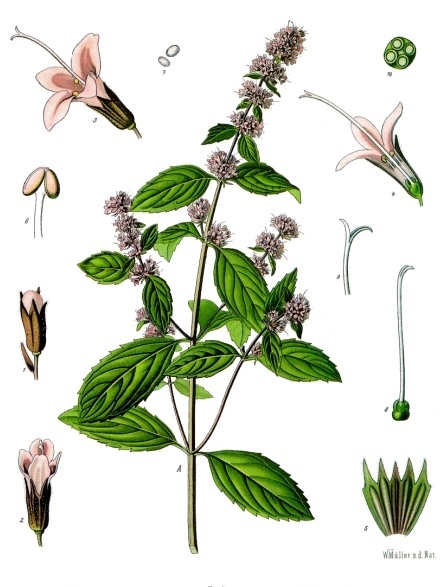
Botanical Description: A perennial herbaceous plant, a hybrid cross between spearmint (Mentha spicata) and watermint (Mentha aquatica). Upright stems grow 12–39 in (30–100 cm) tall, with a square cross-section, from a vigorously spreading underground rhizome. Leaves are 2–3 in (5–8 cm) long with a serrated margin, and are dark green with reddish veins. Flowers are produced in whorled spikes at the top of the stem, and range in color from pink to purple. The entire plant has a characteristic menthol scent.
Harvesting and Safety
Parts Used: Aerial parts, essential oil.
Harvesting Guidelines: Leaves can be harvested whenever present, but are especially potent in late summer when the weather is hot. After being harvested, they can be air dried for storage.
Safety Issues: Peppermint can increase heartburn and gastroesophageal reflux symptoms in some individuals.
Medical Usage
Energetics: Cooling and drying
Actions: Analgesic, antiemetic, antimicrobial, carminative, diaphoretic, digestive tonic, expectorant
Uses: Peppermint is strongly aromatic, with a characteristic menthol scent. It can be used to settle the stomach, relieve digestive upset, and help expel gas (Easley 2016). Clinical trials in the UK and Denmark have confirmed its efficacy in treating irritable bowel syndrome (Chevalier 2016). Applied to the skin, essential oil of peppermint has an antimicrobial effect, relieves pain, and reduces sensitivity (ibid).
Pharmacology: Peppermint contains large amounts of menthol and menthone, as well as flavonoids, phenolic acids, and triterpenes.
Specific Indications:
- For sore throats and productive coughs, an infusion of peppermint leaves can be taken orally, or a diluted essential oil can be used as a chest rub (Chevalier 2016).
- An infusion of peppermint leaves can be drunk to calm nausea, ease cramping and irritated bowels, and expel gas (Easley 2016).
Preparation and Dosage:
- Infusion, 4–8 oz, up to four times daily
- Diluted essential oil, ~15 drops of essential oil per oz of carrier oil, applied topically as needed
Magical Usage
Temperature: Fiery – warm and dry
Astrology: Mercury in Sagittarius
Folklore: Peppermint has a long history of use in healing and purification spells. Mint (of unspecified type) is one of the purifying herbs composing the holy water sprinkler in both the Grimorium Verum and the Greater Key of Solomon. It can be rubbed against furniture, walls, or floors to ward off evil.
Peppermint leaves rubbed on the head were said to relieve headaches, and worn on the wrist were said to ward off illness. According to Pliny, mint leaves could be used to excite love.
Peppermint’s association with Mercury and prolific growth habit make it apt for use in both money and travel spells. Indeed, it can be considered a “mint” in several senses of the word.
References
- Chevallier, A. (2016). Encyclopedia of Herbal Medicine. Penguin Random House.
- Cunningham, S. (2000). Cunningham’s Encyclopedia of Magical Herbs. Llewellyn Publications.
- Easley, T. (2016). The Modern Herbal Dispensatory. North Atlantic Books.