Overview
Closing out our coverage of the three cleansing herbs mentioned in the Grimorium Verum, this week we’re looking at the properties of marjoram. Marjoram is a close relative of oregano, and its medicinal actions are largely similar. In terms of character, marjoram is a little less bold: lighter, sweeter, and more citrusy than its robust cousin.
Medicinally, marjoram eases nervous tensions, lifts the spirits, and cleanses the respiratory system. Its Mercurial associations make it a strong ally in clearing the lungs and supporting the breath. Magically, marjoram is an herb of joy and protection. It is associated both with the goddess Aphrodite and the afterlife, and was used in liminal rituals such as weddings and funerary rites. There is some evidence that the biblical “hyssop” in fact referred to marjoram.
Botany
Common Name: Marjoram, Sweet Marjoram
Botanical Name: Origanum majorana
Family: Lamiaceae
Native Region: Native to the area around the Mediterranean: Cyprus, Turkey, and the Arabian peninsula.
Geographic Distribution: Widely cultivated as a garden herb.
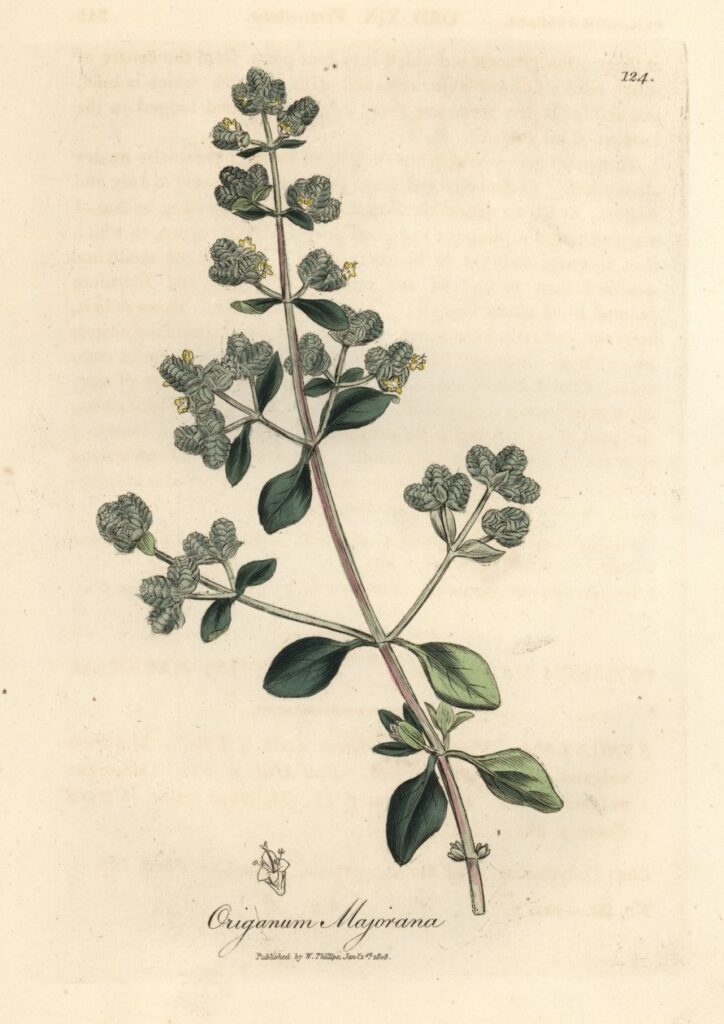
Botanical Description: An herbaceous perennial in the mint family. Marjoram has a compact, bushy growth habit, with simple ovate leaves 0.2–0.6 in (0.5–1.5 cm) long. Leaves are soft, covered in very fine hairs, and smell faintly like citrus or balsam. Flowers range from white to purple.
Harvesting and Safety
Parts Used: Aerial parts, essential oil.
Harvesting Guidelines: Leaves can be harvested whenever present, but are especially potent in late summer when the weather is hot.
Safety Issues: Should be avoided in large quantities during pregnancy. Essential oil is mildly toxic to the liver, and should not be taken internally.
Medical Usage
Energetics: Warming and drying
Actions: Antifungal, antimicrobial, antispasmodic, calmative nervine, carminative, digestive tonic, expectorant
Uses: Marjoram is closely related to oregano (origanum vulgare), and its medicinal uses overlap substantially, however marjoram seems to have a stronger impact on the nervous system – calming anxiety, headaches, and insomnia (Chevalier 2016). In addition to these actions, marjoram can be used to treat flatulence and bloating (ibid). Its actions were described by herbalist John Gerard in 1597 thus:
Sweet marjoram is a remedy against cold diseases of the braine and head, being taken anyway to your best liking; put up into the nostrils it provokes sneesing, and draweth forth much baggage flegme; it easeth the toothache being chewed in the mouth.
Its antimicrobial and expectorant qualities make it excellent for treating infections of the respiratory tract and respiratory congestion (Easley 2016). There are some reports marjoram can decrease sexual drive.
Pharmacology: Marjoram contains a volatile oil containing sabinene hydrate, sabinene, linalool, carvacrol, and other terpenes. Additionally, marjoram is rich in vitamins and minerals: iron, calcium, magnesium, potassium, and vitamins A, C, K, and E.
Specific Indications:
- An infusion of marjoram can be drunk to relieve headaches, calm anxiety, and ease insomnia (Chevallier 2016).
- For gas and bloating, an infusion of marjoram can be drunk, especially after meals (Chevallier 2016).
- For respiratory infection, especially with congestion, the essential oil can be added to a hot water bath, and the vapor inhaled (Herbal Academy 2021).
Preparation and Dosage:
- Infusion, 2–4 oz, up to four times daily
Magical Usage
Temperature: Airy – warm and wet
Astrology: Mercury in Aries
Folklore: Marjoram has long been considered an herb of joy. The ancient Greeks identified it as special to Aphrodite, whose touch gave it its sweet scent. The Romans viewed it as an herb of good luck and happiness, crowning couples with garlands of it as part of the wedding ceremony. In the British isles, marjoram is associated with the Celtic festival of Samhain; growing on a loved one’s grave it signified a happy afterlife.
Finally, it was used as a protective and purifying herb. Marjoram is one of the herbs composing the holy water sprinkler in both the Grimorium Verum and the Greater Key of Solomon. Some scholars have postulated that Biblical references to “hyssop” in fact referred to marjoram (origanum majorana), rather than the modern herb known by the name (hyssopus officinalis).
References
- Chevallier, A. (2016). Encyclopedia of Herbal Medicine. Penguin Random House.
- Cunningham, S. (2000). Cunningham’s Encyclopedia of Magical Herbs. Llewellyn Publications.
- Easley, T. (2016). The Modern Herbal Dispensatory. North Atlantic Books.
- Greer, J. (2005). Encyclopedia of Natural Magic. Llewellyn Publications.
- Heliophilus. (2017). Alchemy Rising: The Green Book. Scarlett Imprint.
- Herbal Academy. (2021). Introductory Herbal Course – Recipes and Monographs. Herbal Academy.