I’ve done some experimentation in the past with making carbon-based inks. Recently I’ve kicked off a new project to make talismanic planetary inks. Inks where the pigment used is an oxide of the planetary metal itself.
I was inspired by a recipe for copper oxide ink found in Jason Logan’s excellent book Make Ink.1 The recipe – aside from being for a truly absurd quantity of ink – is very straightforward: acid, salt, metal. The result is a gorgeous, marine-blue ink.
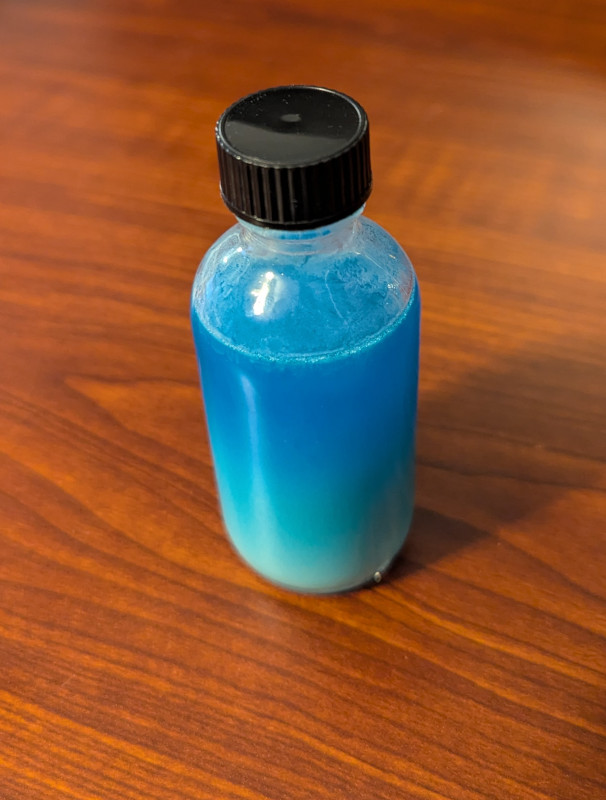
This presents something of a quandary: copper being the metal traditionally associated with Venus, but green being the traditional color. Blue is instead generally associated with the planet Jupiter. Does a blue ink made from copper align more closely with Venus, then, or Jupiter? I’ve opted to go with the former; for me, particles of physical metal carry more planetary resonance than an association on color alone.
So a copper oxide lends itself well to a Venus talismanic ink. I work with a number of Venusian spirits in my personal practice, which made this an obvious entry point into planetary talismanic inks.
The Process
- ½ cup white vinegar
- 1 tsp sea salt
- 1 Tbsp copper scraps (I used a small piece of copper pipe)
- In the planetary day and hour in question (in this case the day and hour of Venus), combine all the ingredients in a glass container.
- Let stand, uncovered, for several weeks in a well ventilated place. Top up with additional vinegar as needed to maintain the starting level.
- Again, working in the appropriate planetary day and hour, strain and bottle the resulting ink.
- Consecrate it in a manner appropriate to the planet. I recited the Orphic hymn to Venus over it, seven times through.
The Result
There are a couple of interesting things to note about this ink. First, I’ve talked in previous posts about the distinction between Type I inks (where the pigment stays solid in suspension) and Type II inks (where the pigment dissolves into solution). This ink appears to be both. There are very fine blue-white particles suspended in a translucent, darker blue liquid. Depending on whether the ink has been shaken or left to stand, the color and opacity can vary. It’s less consistent for writing, but lovely for art.
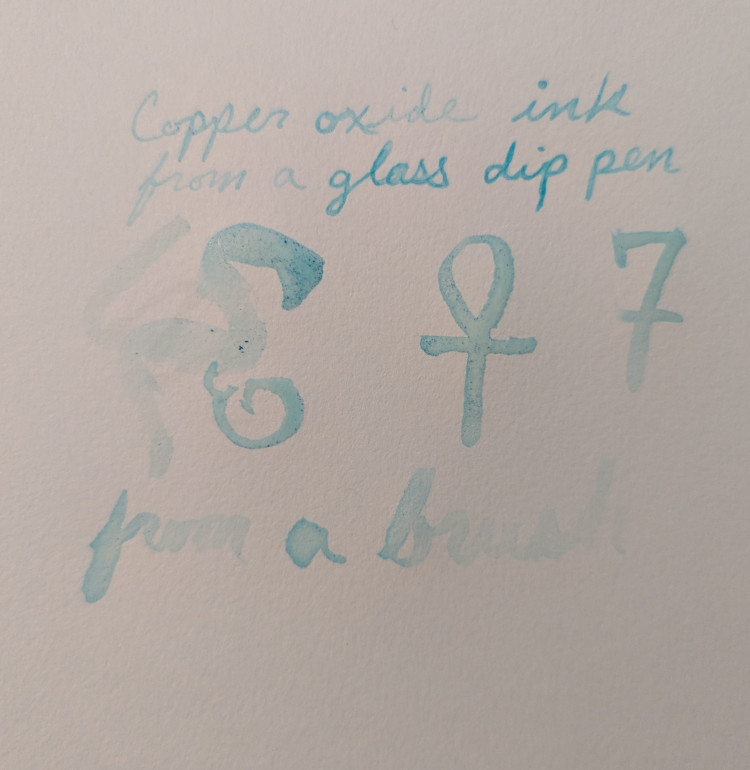
Second, because of the corrosive nature of the menstruum, this is definitely not an archive-quality ink. Over time the color will change and evolve. On a long enough time scale it will eat the paper it’s on. I sort of like that in a talismanic ink; it has a living quality to it that I find appealing. But fair warning: don’t paint it on your diploma or anything.
Finally, I was a little worried going into this about the metal versus color dichotomy mentioned earlier. Would it feel like a Venus ink, or a Jupiter ink? In this case, it was not at all an issue. The Orphic Hymn to Venus contains a number of references to the sea. That, combined with its changeable color, and the fact that – when thickly applied – it dries into glittery crystals, make it 100% a Venusian ink.
The photo really doesn’t do it justice. It’s beautiful.
- Logan, J. (2018). Make Ink: A Forager’s Guide to Natural Inkmaking. Abrams. ↩︎
Leave a Reply