It’s getting to be the time of year where viral illnesses run rampant. As the weather cools off, people spend more time inside. Coupled with travel and large group gatherings around the holidays, this creates the perfect circumstances for germs to spread. Everybody I talk to this week (particularly those with school-aged children) has a friend or family member laid up with the flu.
This seems like a good time to share one of my go-to herbal remedies to fight off colds, flu, and general wintertime crud: Fire Cider. Fire Cider is basically just an extraction of spicy herbs in vinegar – garlic, ginger, horseradish, hot peppers, etc.
The term itself was subject to some controversy. As far as I know, it was coined in the 1970s by herbalist Rosemary Gladstar, and there were many variations and derivative recipes passed around in herbal circles over the next few decades.
In 2012, a small herbal company in Massachusetts successfully filed for a trademark on the phrase “Fire Cider,” which they wanted to make one of their flagship products. They then started sending out cease and desist letters to other herbalists selling products under the name. In 2019 the trademark was overturned, and there was no longer any legal barrier to selling Fire Cider, but in the interim there were a number of alternate names that sprang up for identical formulations.
The recipe I use is adapted from Rosemary Gladstar’s book Rosemary Gladstar’s Medicinal Herbs: A Beginner’s Guide.1 There are four core ingredients, and the a huge number of additional ingredients that can be added to supplement the base recipe. The four core ingredients are garlic, ginger root, horseradish root, and onion (I like to use red onion for the color, but any onion is fine). The onion and garlic are for their antimicrobial and antiviral properties, the ginger warms and settles the stomach, and the horseradish is one of the most potent sinus clearing herbs there is. The four of these are extracted into vinegar, typically apple cider vinegar. That’s pretty much it.
In addition to this basic recipe, there are a whole host of additions people can make. Hot peppers – such as jalapeños or chiles – can be added, either at the beginning of extraction or at the end (it’s a little easier to control the spiciness level at the end). Some folks like to add other herbs that support the respiratory system, such as thyme or rosemary. Or fruit – slices of citrus, cranberries, elderberries, etc. Or winter spices such as cinnamon, allspice, or cloves. Your imagination is really the limit.
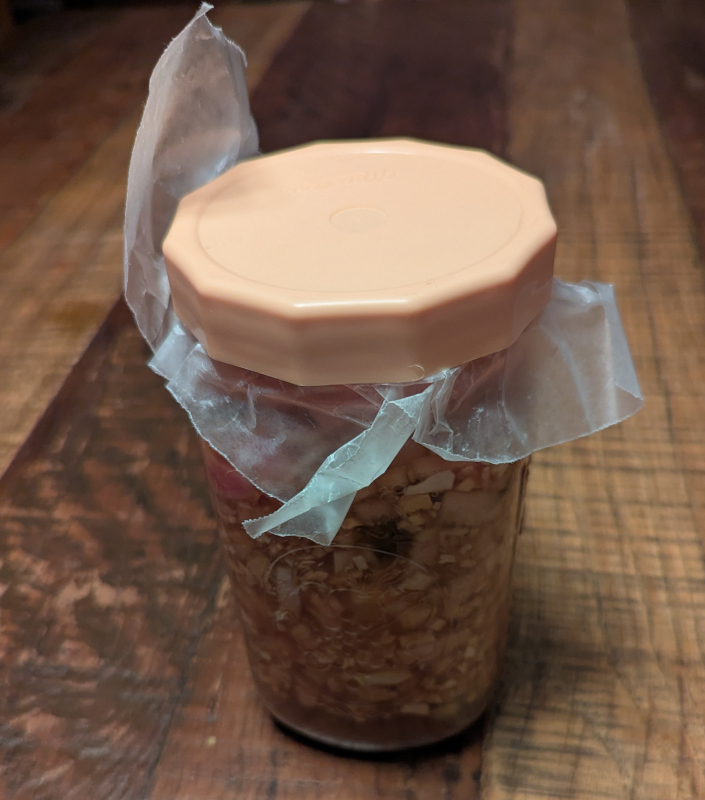
Once the vinegar extraction is done, you can either leave it as-is, or sweeten it with honey into an oxymel. A tablespoon or two a couple times a day will clear the sinuses, fight off sore throats, and generally pep you up. Be warned, it can also cause instant heartburn, unless diluted or chased with something.
Fire Cider
- One small red onion, chopped
- 4–5 cloves of garlic, finely minced
- 4 Tbsp grated ginger root
- 4 Tbsp grated horseradish root
- (Optional: 1 jalapeño pepper, seeds removed and sliced)
- (Optional: 1 thick orange slice, quartered)
- (Optional: 1 thick lemon slice, quartered)
- (Optional: ¼ cup raw cranberries)
- Apple cider vinegar
- In a glass quart jar, combine all the plant ingredients. It should mostly fill your jar.
- Pour warmed (not hot) apple cider vinegar in until the jar is filled. Raw, unfiltered apple cider vinegar is best.
- Close the jar. I like to put a layer of wax paper between the lid and the contents, to prevent corrosion (for metal lids) or anything leaching (for plastic lids).
- Place in a warm place to extract for 3–4 weeks.
- Filter out the herbs and discard them. You should be left with a potent, spicy herbal vinegar.
- If desired, sweeten to taste with honey.
Fire Cider will keep in the fridge virtually forever. Take a tablespoon or two at a time, up to three times daily, when you are sick. Unlike echinacea and elderberry which are most effective when you think you might be starting to get sick, Fire Cider is great for when you are definitively already sick.
- Gladstar, R. (2012). Rosemary Gladstar’s Medicinal Herbs: A Beginner’s Guide. Storey Publishing. ↩︎